AI Consulting
Why Would You Still Need Someone With a Degree, If Anyone Can Handle the Knowledge Question?
Synthetic voice · AI-generated (text-to-speech).
This text first appeared on LinkedIn on 19 October 2026. It is a personal viewpoint, not a consulting recommendation — the sources for the figures mentioned are listed at the end.
In the AI bubble, one big topic right now is the statistic of how little any of us actually know.
Most people only hear from the news or from acquaintances what artificial intelligence can supposedly do and where all this is heading.
Andrej Karpathy, a founding member of OpenAI, posted something interesting on X about a week ago.
Only 0.2 % of people have any experience of what AI in the command line can really do. Only 0.00006 % have had the chance to witness what swarms of agents can do.
So what I have to say comes only from my own small vantage point, as a so-called power user inside that 0.2 %.
The future frightens me — not because I think the world is ending (knocking on wood), but because I notice that humanity is not prepared, and by that I do not even mean the developing world, I mean us.
Nobody can predict the future, but I find it harder and harder to believe that knowledge-based jobs and activities can somehow be preserved within our current ecosystem.
In May 2026, an AI from OpenAI disproved an 80-year-old conjecture by the mathematician Paul Erdős, almost without human help.
What good is your doctorate in strategy consulting if the AI advises anyone with access at professor level?
Why should a human be advised at all? Why not an agent directly?
An agent can work around the clock and many times faster, depending on how well it is designed.
Microsoft CEO Satya Nadella says: AI models are becoming a commodity.
My reading: all providers are converging on the optimal point, the differences become marginal, and in the end price decides.
If that holds, then knowledge-based work becomes a commodity in the same breath. And most people will no longer be needed in the working environment we know.
In May, the head of NVIDIA told graduates that everyone is now standing at the starting line, that nearly everyone has the same conditions for securing their place in the world.
Metaphorically, his point was that everyone now has the same conditions and the same possibilities — but that applies to more than just the students.
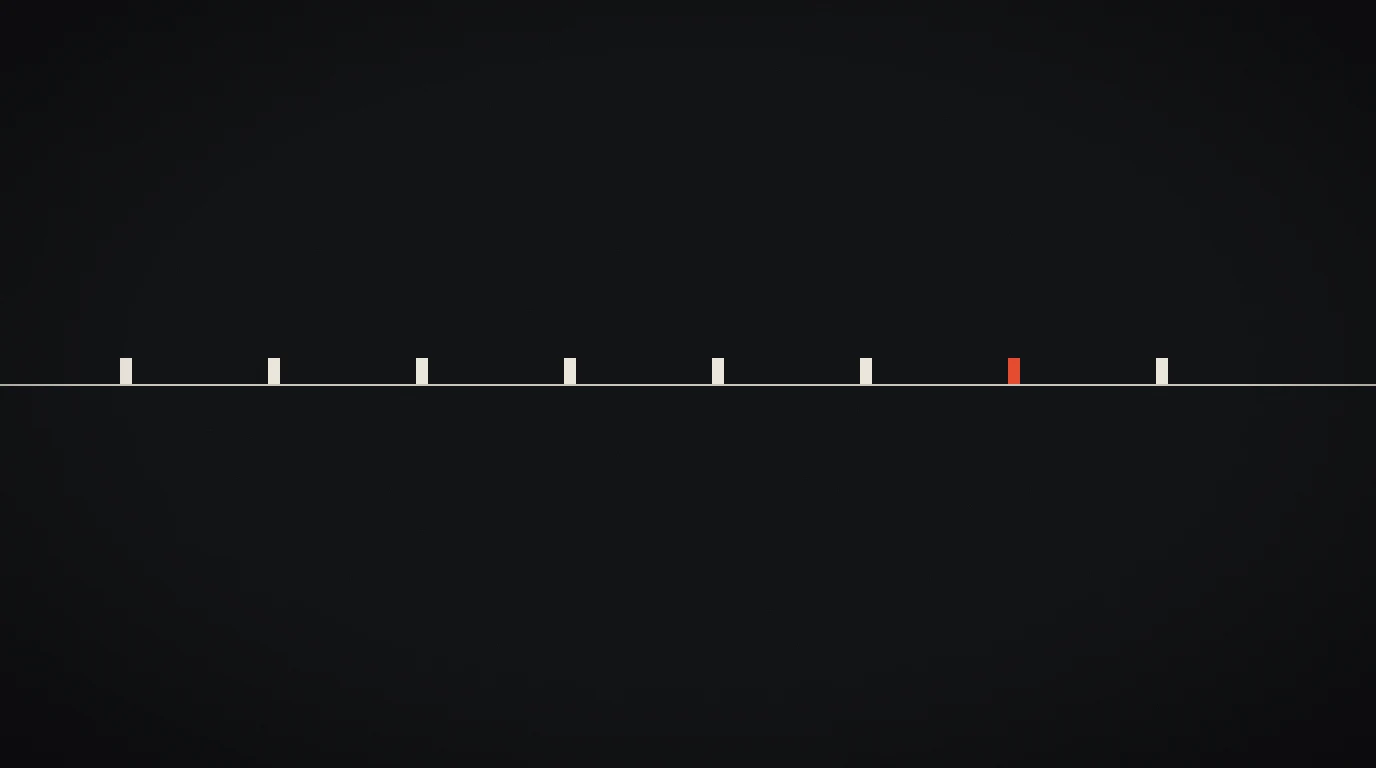
All at the same line, equally equipped — except for the few who know the race has already started.
What happens to those who do not even know that there is a new starting line right now? Who do not want to take part in the competition being held at all?
In our current economic system, it will only be a matter of time before the new state of the art is no longer human teams, and whoever does not keep up gets left behind.
What that means for everyone, I do not know. I only know that the scaling capabilities — and only those I have already seen — make human work at a desk redundant.
All I can advise anyone who plans to work for more than another five years is not to take this lightly. I hope we find a solution to this problem, and do not scale half of humanity into irrelevance.
Sources and context — as of 19/10/2026
- The figures 0.2 % and 0.00006 % come from Andrej Karpathy’s chart „The widening LLM understanding gap” posted on X on 11/10/2026. The chart’s own wording for the 0.00006 % tier (roughly 5,000 people) is „Internal frontier access / Agent swarms”. The 0.2 % tier reads „Frontier use in math & code” — attributing it to the command line is my reading, not the literal wording. Karpathy himself calls his estimate „napkin math”. Reporting: The Decoder
- On Karpathy’s role: he was a founding member of OpenAI from 2015 to 2017 and has worked at Anthropic since May 2026 — Bloomberg Law, 19/05/2026
- The Erdős conjecture: in May 2026 OpenAI reported that an internal model had found a counterexample to a conjecture made by Paul Erdős in 1946. Fields medallist Timothy Gowers stated he would have recommended the work for publication „without any hesitation” had a human submitted it. Assessment by a mathematician: The Conversation, 26/05/2026 · TechCrunch, 20/05/2026. An important caveat: neither article mentions peer review, and in 2025 OpenAI had already prematurely announced solved Erdős problems that turned out to exist in the literature already. This time independent mathematicians assessed the result and built on it.
- Nadella on commoditisation: his words were „the models are getting commoditized” — The Decoder, 09/03/2025. His reasoning there is that models alone are not enough and that the whole system stack decides. The inference about the optimal point and price is my own, and is marked as such in the text.
- The starting line: address by Jensen Huang to graduates of Carnegie Mellon University on 10/05/2026 — NVIDIA blog
- On putting productivity claims in perspective: the best-known controlled study on office work measures 40 % less time and 18 % better quality on short writing tasks — roughly 1.7 times faster, not ten times. Noy & Zhang, Science 2023, summary at MIT News. For agents, no comparable independent study exists so far.
This article states a personal assessment and is neither legal nor investment advice. As of 19 October 2026.

Leon Lotz
Leon Lotz is a business lawyer and founder of MusketierSoftware. He combines legal depth with real software craft.