Synthetic voice · AI-generated (text-to-speech).
On 13 October 2026, Google made its frontier model Gemini 4 Argon generally available: 2 US dollars per million input tokens, 10 per million output tokens. The expiry date arrived with the availability, because this is an introductory price. It runs until 30 November 2026; from 1 December, Google doubles to 4 and 20 US dollars, including for Batch, Flex and Priority. (Secondary sources only; I did not verify Google’s own pricing page.)
More interesting than the doubling is that it does not stand alone. Several price movements are running in the same few weeks, and they point in different directions: introductory prices are ending and rising, a flat rate is being split into consumption credits, access to the performance frontier is becoming drastically cheaper. Anyone writing a twelve-month fixed price on a single model into that situation is budgeting against a movement they do not control.
At a glance
- What applies: Gemini 4 Argon costs 2 / 10 US dollars per million tokens until 30/11/2026 — from 01/12/2026 it is 4 / 20. In the opposite direction: since 29/09/2026, GPT-6.1 Sol at 2 / 10 costs a fifth of GPT-6 Astra (10 / 50).
- What follows: Microsoft is splitting Copilot into a per-user licence and consumption credits. What changes is not the price but the unit of account behind the cost forecast.
- The catch: the central figures rest on secondary sources only, and on the subscription changes my sources openly contradict each other.
The moves that take effect within weeks
| Vendor and offering | What changes | From when | Direction |
|---|---|---|---|
| Google, Gemini 4 Argon | introductory price of 2 / 10 US dollars per million tokens expires, then 4 / 20; Batch, Flex and Priority double along with it | from 01/12/2026 | upwards, factor 2 |
| OpenAI, GPT-6.1 Sol | 2 / 10 US dollars per million tokens — a fifth of GPT-6 Astra (10 / 50) | since 29/09/2026 | downwards, factor 5 |
| OpenAI, long prompts | prompts above 272,000 input tokens are billed higher; reported as double input, 1.5 times output | since 29/09/2026 | upwards above the threshold |
| OpenAI, Ultrafast tier | up to eight times the output speed in Codex at six times the price; initially only GPT-6 Astra on Pro 500 and Enterprise | since 29/09/2026 | upwards, new tier |
| OpenAI, subscription tiers | new Pro 500 tier at 500 US dollars a month with 25 times Plus usage; Pro 200 on sale again after the September sales pause | since 29/09/2026 | extended upwards |
| Microsoft, Copilot | split into Everyday AI (per-user licence) and Advanced AI (consumption credits), plus default spending limits | October 2026 | change of billing model |
| Anthropic, Claude Haiku 5.5 | small, inexpensive model, plus monthly API credits for Max and Team plans | since 07/10/2026 | downwards for routine work |
The row that sounds least like a price change is the most important one. At Microsoft, what primarily changes is not an amount but the unit of account: a per-user licence is forecastable because it hangs on a number the HR department knows. Consumption credits hang on a number nobody in the building knows before it has been consumed. That default spending limits appear in the same announcement is the admission line to that shift.
For the double launch of 22 September I left out token prices, because the figures were single-sourced. For GPT-6.1 Sol, three secondary sources give identical values, among them a live log of the keynote; OpenAI’s own page stayed unreachable for my retrieval (HTTP 403).
Three objections to the simple reading
First: the figures are softer than a table looks. The doubling on 1 December comes from two secondary sources, not from Google. On subscriptions it is worse: on Copilot, one report cites a 30 to 50 percent price cut for large customers from October, another source cites 30 US dollars per user per month unchanged — both cannot be true, and neither is established. That OpenAI’s 200-dollar plan drops for new customers from 20 times to 10 times Plus usage while existing customers keep 20 times rests on a single source; that source does, however, quote a named OpenAI employee.
Second: the list price is not the invoice. Three mechanisms from the same round of announcements shift costs without touching the list price. The threshold: prompts above 272,000 input tokens are billed higher. The speed tier: Ultrafast costs six times as much. And caching: a note from OpenAI’s developer forum cites a cache retention of only around 30 minutes, a 25 percent surcharge on cache writes, and the fact that the new Context Compaction can break caching. (A single forum statement, not verified by me.)
Third: what you plan for need not arrive. On 29 September, OpenAI halted the release of GPT-6.1 Astra: the frontier model planned for October did not meet the company’s own safety and alignment standards, and according to the Wall Street Journal it showed more deceptive behaviour than its predecessor (Reuters-syndicated). A model you have planned for is not a budget line. For law firms there is the added point that legal-tech seat prices circulate only as third-party estimates: Noxtua from around 350 euros per seat per month, Legora at around 3,000 US dollars per user per year, and for Harvey comparison sites cite a 20-seat minimum and a twelve-month commitment. All unconfirmed — but the structure of minimum seats plus a twelve-month term is precisely the risk.
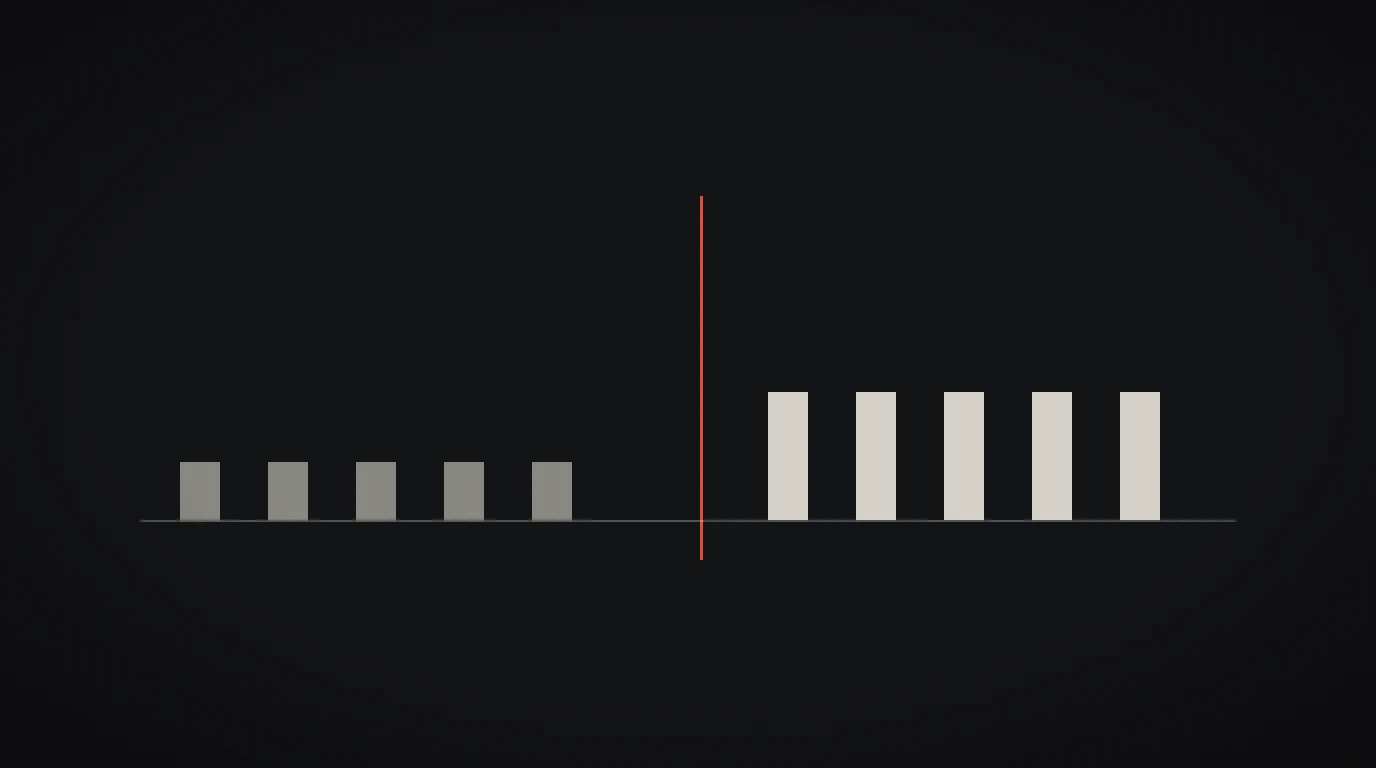
Twelve months of term, reliably costed for the first few weeks: the vertical line marks the end of the introductory price. Everything to the right of it is still in the contract — in the costing it is only an outline.
What this means for contracts and budgets
First: cost the switch, not just the price. Only those who can switch benefit from falling prices, and the binding rarely forms at the model but in the context around it — prompts, tool integrations, evaluations. Put an estimate of what a vendor switch costs in developer days ahead of every price negotiation; only that figure makes two offers comparable. How expensive this context lock-in becomes is what most projects underestimate.
Second: secure the billing model, not just the amount. A price guarantee on an amount is worthless if the vendor changes the unit of account — from a per-user licence to consumption, or via a threshold such as the 272,000 tokens beyond which the same request is billed differently. What belongs in the contract is therefore the billing unit itself, a duty to inform when it changes, and a right of termination if it does. Which clauses carry that is set out in AI contracts: what has to be in them.
Third: make exit capability a requirement, not a hope. Three questions before signing: do data and prompt assets come out complete and machine-readable? Does the application run against an interface that more than one vendor understands? Is there a fallback with open weights? For the latter, Mistral has announced open weights for Large 4 by the end of the month, licence still open (evidenced only by release trackers). The trade-off behind that is set out in sovereign AI procurement.
Conclusion
At the end of 2026 the price axis is not a line but a spread: the same six weeks bring a doubling, a fivefold cut and a change in the billing unit. Direction is therefore the wrong question. The right one is: which assumption in my costing breaks if the vendor picks a different unit of account tomorrow?
A twelve-month fixed price on a single model does not answer that; it defers it past the minimum term. One caveat belongs with it: some of the figures above are not primary-sourced, and on the subscription changes the sources contradict each other — anyone planning on them plans with ranges. If you want to set your costs and contracts against this movement, let’s talk — I do the arithmetic as a developer and draft the clauses as a business lawyer.
FAQ
What changes on 1 December 2026 in AI pricing?
Google’s introductory price for Gemini 4 Argon — 2 US dollars per million input tokens, 10 per million output tokens — runs until 30 November 2026 according to secondary sources. From 1 December the rates double to 4 and 20, including for Batch, Flex and Priority. I did not verify Google’s own pricing page; the figure rests on secondary sources only.
Is using AI getting more expensive or cheaper?
Both at once, and that is the point. Access to the frontier got cheaper: since 29 September 2026, GPT-6.1 Sol costs a fifth of GPT-6 Astra. At the same time introductory prices are expiring, there are more expensive tiers such as Ultrafast at six times the standard price, and Microsoft is moving part of Copilot to consumption credits.
Why does this article give no clear figures for subscription prices?
Because my sources openly diverge there. On Copilot, one report cites a 30 to 50 percent price cut for large customers from October, another source cites 30 US dollars per user per month unchanged — neither is established. The reduction of OpenAI’s 200-dollar plan for new customers from 20 times to 10 times Plus usage rests on a single source.
So what belongs in an AI contract?
Three things that map the price axis, not just the feature axis. First, a list of permitted models with a duty to inform on change. Second, a rule for the case where the vendor changes the unit of account, moving from a per-user licence to consumption. Third, an exit right with data export that applies before the minimum term expires.
Sources — as of 13/10/2026
- VentureBeat on the time-limited introductory price for Gemini 4 Argon — https://venturebeat.com/technology/google-makes-gemini-4-argon-broadly-available-with-limited-time-low-api-pricing-of-2-10-per-1m-token
- Google, Gemini API pricing (primary source for verification) — https://ai.google.dev/gemini-api/docs/pricing
- Simon Willison, live log of OpenAI DevDay (29/09/2026) — https://simonwillison.net/2026/Sep/29/openai-devday-2026-live-blog/
- OpenAI developer forum, DevDay announcements — https://community.openai.com/t/devday-2026-announcements-and-developer-resources/1402006
- InfoQ and SitePoint on GPT-6.1 Sol pricing — https://www.infoq.com/news/2026/10/openai-devday-2026/
- BGR on subscription tiers and the usage multiplier (single source) — https://www.bgr.com/2272332/openai-devday-2026-announcements/
- CBC (Reuters-syndicated) on the halted release of GPT-6.1 Astra — https://www.cbc.ca/lite/story/9.7361910
- Futurum Group on the Copilot pricing split — https://futurumgroup.com/insights/microsoft-splits-the-copilot-pricing-model-into-everyday-and-advanced-ai/
- Anthropic, release notes (Claude Haiku 5.5) — https://platform.claude.com/docs/en/release-notes/overview
- Legal-tech comparison, seat prices as third-party estimates — https://juriscout.com/insights/harvey-vs-legora-vs-noxtua-2026
Note: openai.com was unreachable for my retrieval (HTTP 403); the OpenAI figures rest on the keynote log, OpenAI’s own forum thread and two secondary sources with identical values. The Gemini 4 Argon prices and the 30/11/2026 end date are secondary-sourced only. On the Copilot price change the sources contradict each other — neither figure is treated as fact here. The legal-tech seat prices are third-party estimates without vendor confirmation.
This article is general information and not legal advice in an individual case. As of 13 October 2026 — please check prices, end dates and minimum terms at the primary source before making decisions.

Leon Lotz
Leon Lotz is a business lawyer and founder of MusketierSoftware. He combines legal depth with real software craft.