Synthetic voice · AI-generated (text-to-speech).
On June 12, 2026, one of the most capable AI models in the world disappeared from the market within a few hours. No server crash, no billing error, no bankruptcy — instead, a legally binding directive from the US government. Anyone who had hard-wired their application to this model woke up the next morning to a silent system: API calls ran into the void, no migration was prepared, and the contracts with their own customers ran on unchanged.
The case is more than a tech headline. It is a stress test for an assumption baked unspoken into many architectures: that an AI model, once integrated, will still be reachable tomorrow. I dissect it here from the two angles that belong together — the technical one (how do you build dependency so it does not become a trap?) and the legal one (who is liable when it does?). The result is not a case against AI, but a checklist against the next headline that hits your system.
At a glance
- What happened: On June 12, 2026, Anthropic shut down Fable 5 and Mythos 5 worldwide to comply beyond any doubt with a US government directive (an access ban for non-US nationals). Other models stayed available.
- The lesson: The availability of an AI model has become a legal-political variable, not a technical one. Single-vendor hard dependency is therefore both a resilience risk and a liability risk.
- The safeguard: A multi-model architecture (interchangeability), an AI asset inventory, and contracts that deliberately address force majeure, exit rights, and liability toward your own customers.
What actually happened
First, the facts, cleanly separated from speculation — because precision matters most with a topic this charged.
A few days earlier, Anthropic had introduced two new models: Claude Fable 5, the company’s most powerful broadly available model, and its sibling model Mythos 5, which was accessible only through a separate program. The documented trigger was not an abstract safety concern but a concrete incident: Amazon discovered a jailbreak of Fable/Mythos that got the models to reveal usable information for a cyberattack — a finding that, according to consistent reporting, Amazon CEO Andy Jassy escalated personally. On top of that came the suspicion that a China-linked group was connected to the misuse. On June 12, 2026, Anthropic then received a legally binding government directive to suspend all access to these two models for “any foreign national” — that is, for anyone without US citizenship; officially justified on grounds of national security and export controls.
Separating users by citizenship in live operation was not practicable. So Anthropic shut down Fable 5 and Mythos 5 for all customers worldwide to comply with the directive beyond any doubt. All of the provider’s other models remained unaffected. Anthropic followed the directive but disagreed with it sharply on the merits: applied industry-wide, this standard “would essentially bring all new model releases from every frontier model provider to a halt.”
For context, because the wording matters: the media speak of a “ban.” The more legally precise term is a government-ordered access suspension in the context of export-control law — not a blanket, permanent product prohibition. This distinction is not hairsplitting. It determines which contractual and liability categories even apply.
Transparency note on the current state: What is confirmed is the event of June 12, 2026, and the worldwide shutdown. Several independent outlets additionally report a government-set 90-minute deadline for implementation as well as the China angle of the triggering incident — both go beyond Anthropic’s official statement but are corroborated by more than one newsroom.
Update (as of 18 June 2026): Access to Fable 5 (and Mythos 5) remains suspended; there is no official restoration date. Both Anthropic and the US administration are pushing for a return: White House AI adviser David Sacks said the goal is that, once the safety issue is remediated, the export control is lifted and “Fable goes back into general release — as soon as possible.” Anthropic is working with the authorities on a compliant access model. No date is set; the case is being actively watched (including on prediction markets). Re-check the current state before any definitive statement.
The real lesson: availability risk is vendor lock-in
What is remarkable about this case is not the politics behind it, but the mechanics. A globally available product was gone from one moment to the next, with no technical fault at all — solely because of an administrative decision made over the heads of its users.
For any company that has built an AI model into its product as a hard dependency, this was a single point of failure that materialized. This is precisely where the business insight lies: model redundancy is no longer merely a question of cost or performance. It is a resilience requirement.
The technical and organizational consequences can be stated clearly:
- Model redundancy and fallbacks: Never build in a single hosted model as an indispensable dependency. Keep multiple providers, or at least multiple models, on hand that you can switch between.
- AI asset inventory: Know where in your own system which model is actually used. Only those who know the blast radius can react quickly when it counts.
- Guardrails instead of a kill switch: Monitor and constrain individual functions, rather than making the entire system depend on a component that someone else can disable at any time.
Some providers — Anthropic among them — offer fallback mechanisms in their interfaces for such cases, automatically routing an unanswerable request to a different model. That is useful, but it does not solve the underlying problem of a complete government-ordered shutdown. The real safeguard lies in the architecture: a multi-model design instead of a single-vendor hard dependency. Anyone who has software built to order can plan for this interchangeability from the outset — a concrete advantage over off-the-shelf solutions rigidly tied to one provider. I have laid out the concrete clauses and architectural patterns for this in detail in the guide to avoiding AI vendor lock-in.
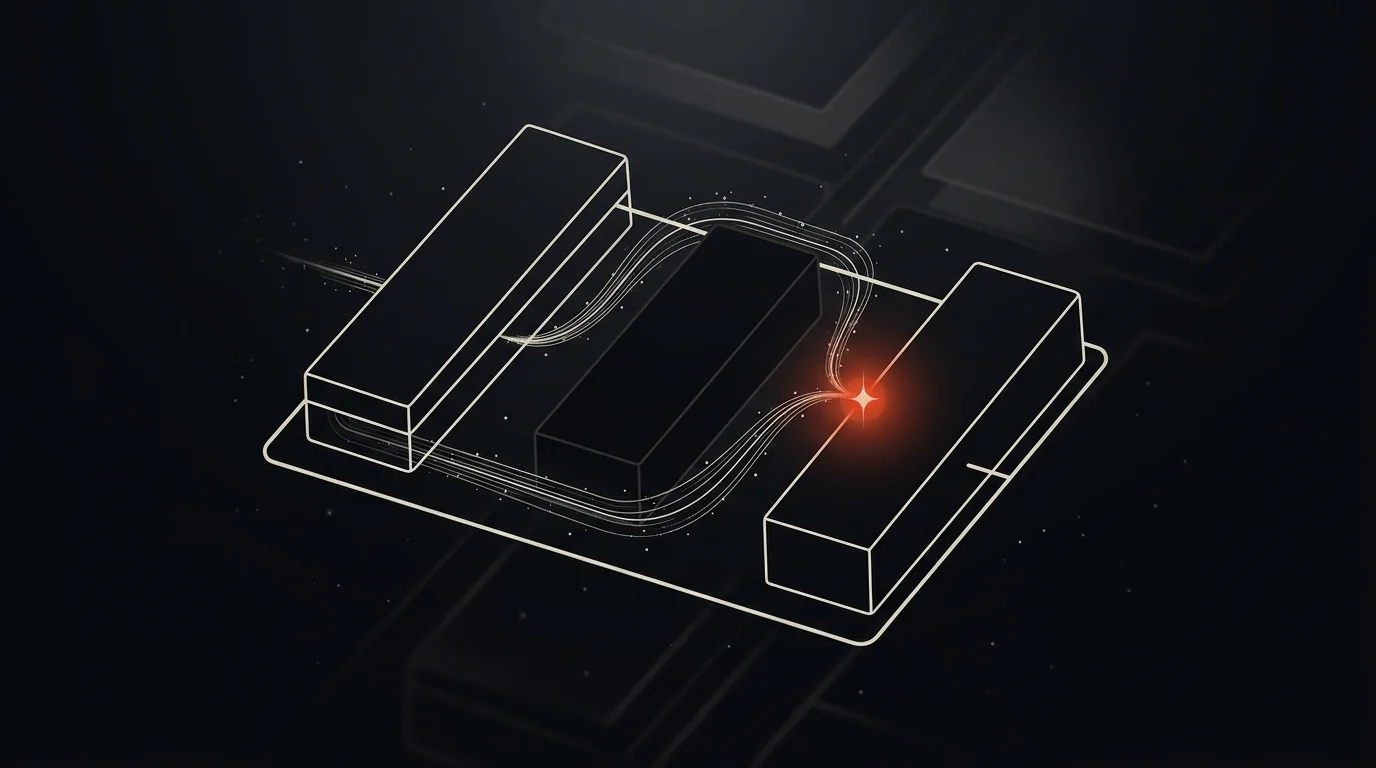
Single point of failure versus multi-model design: keeping models as interchangeable building blocks behind an abstraction layer means you survive the outage of a single provider — whether the cause is technical or regulatory.
The legal and contractual dimension
This is where it gets serious for business owners — and where it becomes clear why the technical and legal perspectives belong together. The following points are general legal orientation, not advice on any individual case. But they outline the questions everyone who uses third-party AI models should be asking.
Force majeure and compliance clauses. When facing government-mandated shutdowns, providers typically invoke “compliance-with-law” or force majeure clauses. Service-level agreements often expressly carve out such cases from their availability guarantees. In plain terms: the usual “99.9% availability” is of no help to you precisely when an agency pulls the plug. Doctrinally, German law treats such a permanent government-imposed block as impossibility under § 275(1) BGB — the provider is released from the obligation to perform, and in turn, under § 326(1) BGB, your obligation to pay falls away. If the block is only temporary, the more fitting category is frustration of contract / disturbance of the basis of the transaction (§ 313 BGB), with adaptation rather than termination as the consequence. A force majeure clause merely shifts this statutory allocation by contract — it is therefore only as good as its definition of the event (does it even capture “governmental action / export controls”?) and its legal consequence. Check concretely: does the contract provide exit rights, pro-rata refunds, or service credits for such scenarios — or merely an indemnity for the provider?
Liability toward your own customers. This is the most dangerous blind spot. If you build a product on someone else’s model and resell it to your own customers, you may be liable to them regardless of the fact that the cause lies with the upstream provider. The core of the problem is an asymmetric allocation of risk: in the provider ↔ you relationship, the block releases the provider (§ 275 BGB, above). In the you ↔ customer relationship, however, that same relief does not apply automatically — whether you can invoke impossibility depends on what you owed: if you owed a specific model, performance falls away; if you owed merely “a working AI function,” you remain obliged to procure a replacement model and, without a prepared fallback, you quickly fall into default (§ 286 BGB) or owe damages (§ 280 BGB), plus, in the case of work contracts, warranty liability (§§ 633 ff. BGB). It is precisely this asymmetry that back-to-back clauses capture: they pass the force majeure and liability limits from the upstream contract through to your customer congruently. A robust clause names the triggering event concretely (e.g., “government-ordered or export-control-mandated unavailability of a third-party model”), states a response deadline together with a replacement-model obligation, and caps liability in amount. Which points a robust AI contract must cover for this I address separately in AI contracts: what really has to be in them.
Export-control and embargo law. The case shows unmistakably that AI models can fall under export-control and security law — up to and including access bans based on citizenship. For German and European companies, this is not a purely American phenomenon: the EU Dual-Use Regulation establishes a comparable regulatory regime that could, in theory, trigger similar effects.
Data protection and data processing agreements. A suddenly forced model switch may change the assumptions underlying your data-protection documentation: a different sub-processor, a different data flow, a different model infrastructure. Anyone who has not thought through their data processing agreements (DPAs) and data flows with switching scenarios in mind faces, when it matters, an unplanned GDPR problem on top of the technical outage. When switching between US- and EU-hosted models in particular, it is worth looking first at the data-sovereignty and third-country-transfer question.
The more common case: planned model deprecation
As spectacular as a government intervention is, the far more common lock-in scenario is more mundane and hits everyone sooner or later: the planned deprecation of models. Providers retire older model versions with fixed shutdown dates. Anyone who has hard-wired their application to a single model ID then has to migrate under time pressure — often with altered response behavior that has to be retested.
The countermeasures are the same as for the big bang: version pinning with deliberately planned migration paths, a re-test concept for every model switch, and an architecture that treats the model in use as an interchangeable building block — not as an immovable foundation.
In concrete terms, being “migration-ready” means being able to demonstrate four things — for both the planned and the forced switch:
| Question | If the answer is “no” … | Measure |
|---|---|---|
| Do you know where each model runs across your system? | You do not know the blast radius and will react blindly when it counts. | An AI asset inventory, continuously maintained. |
| Is there a tested fallback to a second model/provider? | An outage takes the affected function down completely. | An abstraction layer plus at least one proven secondary path. |
| Do you have an eval suite that automatically checks a model switch? | Every migration is a manual risk with altered response behavior. | Regression/eval tests per critical use case. |
| Do your contracts (up- and downstream) govern the outage? | The availability and liability risk stays stuck with you. | Review force majeure, exit, and back-to-back clauses. |
What this has to do with the AI Act
The Fable 5 ban and the EU AI Act are two different matters — one is export-control law, the other product regulation. But they point in the same direction: AI models are regulated goods, and their availability increasingly depends on legal decisions, not just technical ones. That this is no theoretical scenario is shown by the AI Act itself: its obligations for providers of general-purpose AI (GPAI) models have, under the staggered application of Art. 113(b), already been in effect since 2 August 2025. Anyone who is already inventorying and classifying their deployed AI systems as part of the AI Act has already done half the work toward a robust resilience concept. The inventory that the AI Act suggests anyway is exactly the AI asset discovery you need for the worst case of a shutdown. What the AI Act concretely requires of companies I summarize in The EU AI Act & GDPR — what companies need to do now.
Conclusion
The Fable 5 ban is no reason to avoid AI models — they have become too valuable. But it is a clear signal to integrate them correctly. Anyone who makes a single model the indispensable foundation takes on an availability risk they do not control and that, as this case shows, can materialize within hours.
The answer lies in the interplay of technology and law: an architecture that keeps models interchangeable, and contracts that deliberately allocate availability, liability, and data-protection risks. It is precisely this combination — robust custom software and legally well-considered safeguards — that is the most effective protection against the next headline that affects your system.
This intersection of architecture and contract is exactly where I work, as a developer and business lawyer in one person. If you want to know how vulnerable your stack is to a shutdown like this, let’s talk about it.
FAQ
Was Claude Fable 5 permanently banned?
No. The accurate term is a government-ordered access suspension in the context of export-control law — not a permanent product prohibition. Anthropic shut down Fable 5 and Mythos 5 worldwide because separating users by citizenship in live operation was not practicable. Whether and since when access has been restored cannot be substantiated from the available sources (as of June 12, 2026) and should be re-checked before any definitive statement.
Does an SLA with “99.9% availability” protect me?
In this scenario, usually not. Service-level agreements typically carve out government-mandated shutdowns from their availability guarantees via force majeure or “compliance-with-law” clauses. The availability promise therefore does not apply to a regulatory intervention — check exit rights and service credits instead.
Am I liable to my own customers if the upstream model fails?
Possibly, yes. Your customer has a contract with you, not with the AI provider. Without clean “back-to-back” clauses and liability limitations, the risk of the upstream outage can get stuck with you. This is not legal advice for an individual case, but it is the first point every contract should address.
Could this also hit European providers?
In principle, yes. The specific case rests on US export-control law, but the EU Dual-Use Regulation establishes a comparable regulatory regime that could, in theory, trigger similar effects. The lesson is provider-independent: availability has become a legal-political variable.
What is the first concrete step toward protection?
An AI asset inventory: where in your own system does which model run, and which function breaks if it fails? Only once you know the blast radius can you decide sensibly about fallbacks, eval tests, and contract clauses. This inventory largely overlaps with the one the AI Act suggests anyway.
Sources — as of 18.06.2026
- Anthropic (primary source): Statement on the US government directive to suspend access to Fable 5 and Mythos 5 — https://www.anthropic.com/news/fable-mythos-access
- NBC News: How the Trump administration took Anthropic’s Fable 5 AI offline (incl. David Sacks on the intended return) — https://www.nbcnews.com/tech/security/anthropic-fable-5-ai-offline-trump-order-administration-claude-rcna350117
- InfoQ: Anthropic Releases and Temporarily Suspends Claude Fable 5 — https://www.infoq.com/news/2026/06/claude-5-release/
- Return status (as of 18.06.2026, not yet restored): explainx — When Will Fable 5 Be Available Again? — https://explainx.ai/blog/when-will-fable-5-be-available-again-2026
- Anthropic: Introducing Claude Fable 5 and Claude Mythos 5 — https://www.anthropic.com/news/claude-fable-5-mythos-5
- Al Jazeera: US orders Anthropic to disable AI models for all foreign nationals (2026-06-13) — https://www.aljazeera.com/news/2026/6/13/us-orders-anthropic-to-disable-ai-models-for-all-foreign-nationals
- CNBC: Anthropic disables access to Fable 5 and Mythos 5 to comply with government directive (2026-06-12) — https://www.cnbc.com/2026/06/12/anthropic-disables-access-to-fable-5-and-mythos-5-to-comply-with-government-directive.html
- Snyk: When a Government Pulls an AI Model: What the Fable 5 and Mythos 5 Suspension Means for Security Teams — https://snyk.io/blog/fable-mythos-suspension-security-takeaways/
- TechCrunch: Anthropic’s safety warnings may have just backfired (2026-06-12) — https://techcrunch.com/2026/06/12/anthropics-safety-warnings-may-have-just-backfired-the-government-has-pulled-the-plug-on-its-most-powerful-ai/
- Regulation (EU) 2024/1689 (AI Act), Art. 113 — staggered application; GPAI obligations applicable since 2 August 2025 — https://artificialintelligenceact.eu/implementation-timeline/
This is general information, not legal advice.

Leon Lotz
Leon Lotz is a business lawyer and founder of MusketierSoftware. He combines legal depth with real software craft.